
API Development: REST, SOAP, gRPC & AI-Driven Integrations
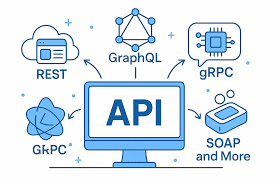
API Development: REST, SOAP, and gRPC
Scalable REST APIs – Lightweight and widely adopted
Secure SOAP APIs – Ideal for enterprise & regulated industries
High-Performance gRPC – Optimized for microservices & streaming
Multi-Protocol Support – Tailored to project-specific needs
Robust Security Standards – OAuth, JWT, and encryption mechanisms
Modern enterprises rely on seamless interoperability between applications, platforms, and devices—and APIs serve as the backbone of this connectivity. As a technology consulting partner, we design, architect, and implement API ecosystems that are secure, scalable, and enhanced with AI-driven intelligence and automation for long-term business growth.
⬤ RESTful API Engineering
We design lightweight, stateless, and scalable REST APIs, enhanced with AI-powered data processing and intelligent services.
Our expertise includes:
- Development using Spring Boot, Express.js, and Flask
- JSON-based communication optimized for high performance
- Security implementations including OAuth2, JWT, and RBAC
- Adherence to best practices for scalability and maintainability
- Integration with AI/ML services for intelligent features and real-time insights
⬤ SOAP Web Services for Enterprise Systems
For structured, standards-driven integrations, we build SOAP services enhanced with AI-assisted validation and intelligent data processing.
Our implementations deliver:
- Enterprise-grade WS-Security, XML Encryption, and Schema Validation
- Reliable, strongly typed messaging for regulated industries
- High-assurance communication with governance and documentation
⬤ gRPC for High-Performance Microservices
We architect high-speed APIs using gRPC, optimized for AI-driven real-time processing and communication.
Key capabilities include:
- Efficient binary serialization with Protocol Buffers
- HTTP/2-based multiplexing for faster communication
- Bi-directional streaming for real-time apps, IoT, and microservices
- Ideal for scalable, cloud-native, and distributed architectures
⬤ API Gateways & Intelligent Management
We integrate platforms such as AWS API Gateway, Kong, and Apigee, enhanced with AI-based traffic analysis and anomaly detection.
These platforms enable:
- Centralized authentication & access control
- Traffic management (throttling, rate limiting)
- Caching, observability, and analytics
- Secure and consistent API delivery
⬤ Versioning, Lifecycle & Intelligent Evolution
We implement API lifecycle strategies with AI-assisted impact analysis and version optimization.
Includes:
- URI-based versioning
- Header-based negotiation
- Media-type versioning
This ensures maintainability with data-driven evolution of APIs.
⬤ Testing, Monitoring & AI-Driven Insights
Our validation pipelines are enhanced with AI-based performance analysis and predictive monitoring.
Includes:
- Functional testing via Postman and SoapUI
- Performance testing using JMeter
- Automated CI/CD integration
⬤ Integration, Compliance & Intelligent Ecosystems
We design APIs supporting enterprise ecosystems with AI-enabled integrations and automation.
Supports:
- Third-party integrations (fintech, ERP, CRM)
- Industry protocols: ACH, ISO 20022, Open Banking
- Regulatory compliance: PCI DSS, HIPAA
FAQs
- What are the key differences between REST, SOAP, and gRPC?
REST, SOAP and gRPC are very different from each other with respect to their underlying principles. REST is the lightweight mean of communication chiefly employed in web services. In contrary, SOAP is a protocol with strict standards in security. Last, but not least, gRPC has high-performance capabilities,
and streaming is one of the options listed under its features. - When should I use gRPC over REST or SOAP?
gRPC is intended to replace REST or SOAP used for internal communications between microservices at low latency for applications that are highly throughput-oriented. - Is SOAP still relevant for building APIs today?
Yes, because SOAP is an interface specification that everyone knows and understands where you may require high security and compliance to transactions-for example, finance or healthcare industries. - Which type of API is most suited for mobile applications?
Most likely REST API, as proved by its simplicity, lightness, JSON usage, and seamless operation with mobile and web apps. - What kind of security would that ensure on such protocols?
OAuth; API keys; JWT tokens; TLS encyption; and such methods such as WS-Security for SOAP.